Stacked geospatial data layers
All case studies Case study · Applied ML & Automation · Energy

Scouting a nation for
grid-scale batteries.

For a developer building a Swiss battery-storage portfolio, LambdaOrbit built the engine that finds the ground: it scans every industrial parcel in the country, scores each one for grid-connection suitability, and produces the dossiers and grid-operator outreach needed to act — at a scale no analyst could reach by hand.

Aerial and map view from a generated site dossier
The brief

Find the few sites worth
a developer’s time —
across a whole country.

A grid-scale battery needs a rare combination: an industrial parcel of the right size and shape, close enough to a substation with spare capacity, clear of contamination and natural-hazard zones, and reachable for heavy transport. Finding those needles by hand, canton by canton, is impossibly slow. The brief was to do it systematically — rank every candidate in the country, and hand a developer a shortlist they can act on tomorrow.

DomainEnergy / storage
MethodGeospatial scoring
OutputDossiers + outreach
At a glance

From a country
to a shortlist.

One national scan, narrowed by evidence to the handful of sites worth pursuing — and packaged for the people who decide.

5,471
industrial parcels scanned nationwide from open map data
7
scoring dimensions per parcel on a transparent 43-point model
142
priority sites surfaced as genuinely worth pursuing
17
grid operators packaged for parallel, ready-to-send outreach
01 · The search

Every parcel,
checked against reality.

The pipeline pulls every industrial- and commercial-zoned parcel in Switzerland from open map data, then tests each against the physical constraints that actually decide a project. For every candidate it finds the nearest substation, measures the real routed cable distance rather than a straight line, and screens the parcel against contaminated-land registers, natural-hazard maps and the federal building registry.

All of it runs in the official Swiss coordinate system, so distances and areas are measured the way an engineer would, not approximated.

Network of candidate sites linked to grid nodes
02 · The score

A transparent,
seven-part verdict.

Every parcel earns a score on seven independent dimensions. The weighting is deliberate and legible — no black box — so a developer can see exactly why a site ranked where it did.

D1

Zoning  ·  weight 8

How well the parcel’s land-use designation fits utility-scale storage, with an exact-versus-heuristic match on the zone type.

D2

Grid proximity  ·  weight 8

Routed cable distance to the nearest suitable substation, banded so that closer connections score materially higher.

D3

Geometry  ·  weight 7

Usable area, compactness and minimum width — does the shape actually fit a containerised battery yard with realistic setbacks?

D4

Access  ·  weight 5

Road frontage, road class and heavy-truck reachability for delivery and installation.

D5

Neighbours  ·  weight 3

Residential clusters and the mix of land use within a 250-metre ring — a proxy for permitting friction.

D6

Environment  ·  weight 7

Contaminated-land registers, natural-hazard zones, protected areas, and proximity to forest and water.

D7

Confidence  ·  weight 5

How much the evidence can be trusted — source count and data-quality flags — so thin data never masquerades as a strong site.

03 · The deliverable

What a developer
actually receives.

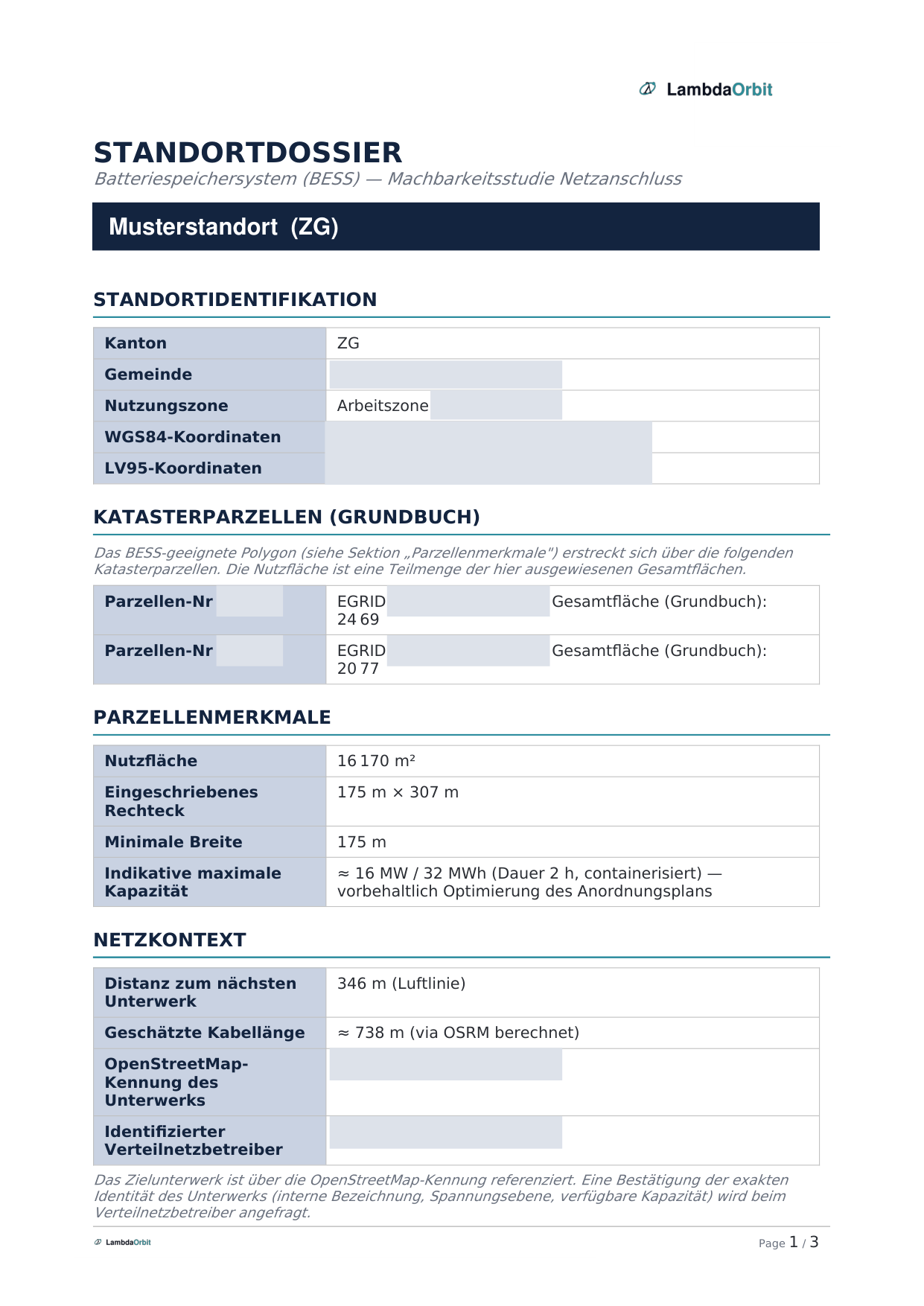
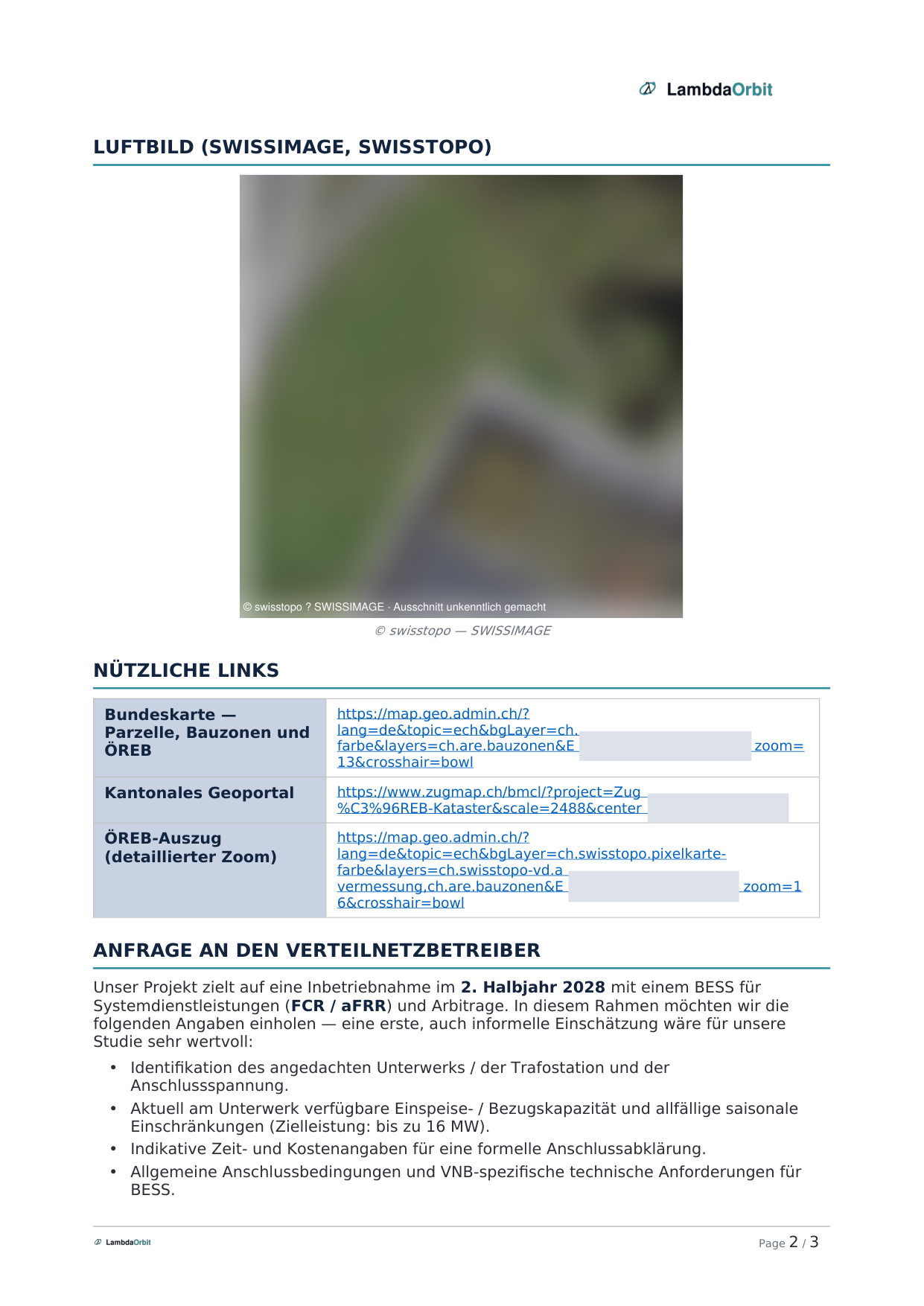
Each priority site becomes a clean, A4 dossier in the language of its canton — ready to put in front of an investment committee or a grid operator. Below is a genuine output, shown as a representative example: client branding, contact details and the site-identifying specifics (exact parcel, coordinates, aerial and grid operator) have been removed or obscured.

Site dossier page 1: identification, parcels and grid context
Site dossier page 2: aerial view, official map links and grid-operator request
Open the sample dossier (PDF)

Generated automatically — site identification, cadastral parcels, grid context, official map links and a ready-to-send connection enquiry, produced for every site in the shortlist.

Outreach tracker and contact data
04 · The outreach

A pipeline, not
just a map.

Finding sites is only half the job — someone has to be contacted. The system groups the shortlist by responsible grid operator, ranks operators by the total capacity in their territory, and generates a tailored outreach package and tracker for each one, in the right language.

The result is a single ranked workstream: the developer can approach the operators that unlock the most megawatts first, with the evidence already in hand.

Outcome

A continent-scale search,
made actionable.

What began as an open question — “where in Switzerland should we build?” — became a ranked, evidence-backed pipeline of 142 sites across 17 grid operators, each with a dossier and an outreach path ready to go. Work that would have taken a team months of manual research runs end to end on demand and refreshes as the underlying data changes.

It is the same approach LambdaOrbit brings to any data-rich problem: combine messy public data into one honest score, automate the document and outreach grind, and hand the client something they can act on — not just a spreadsheet.

Discuss a pipeline like this
Ranked grid of candidate sites
Note The dossier shown is a genuine output of this system, reproduced as a representative example: client branding, contact details and the specifics that identify the real site (exact parcel numbers, coordinates, aerial imagery and grid operator) have been removed or obscured. Site data is drawn from public Swiss sources — © OpenStreetMap contributors, © swisstopo, ARE, BAFU and the ÖREB cadastre. It is presented to illustrate the engineering approach and is not investment advice or a solicitation of any kind.
Build something like this

Have a search across
messy real-world data?

If your problem means combining public or proprietary datasets into a ranked, defensible shortlist — and turning each result into a deliverable — that is exactly where LambdaOrbit works best.

Start a conversation